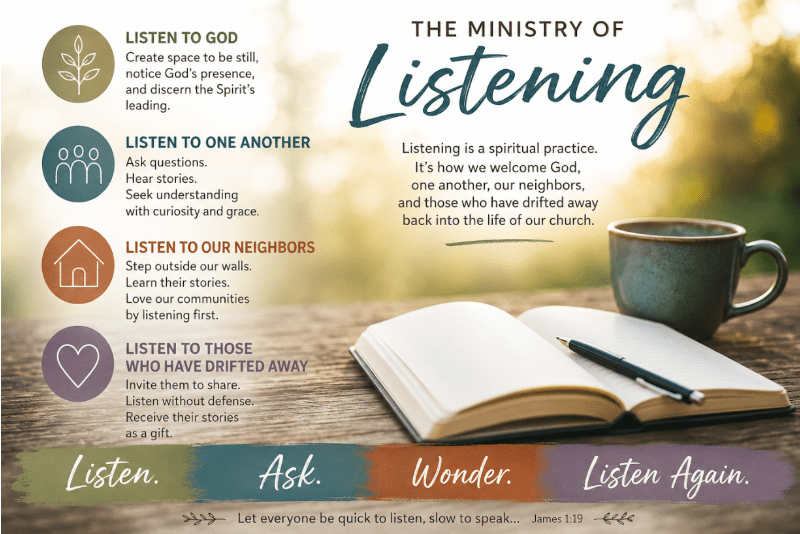

What if one of the most important ministries we can cultivate in our churches right now is also one of the simplest? Listening.
We live in a time when churches are asking important questions. How do we engage our communities? How do we welcome new people? How do we nurture faith? How do we respond to changing patterns of participation? What is God calling our congregations to become?
Often, our first instinct is to look for answers: to develop a new program, make a plan, fill a calendar, or figure out the next faithful thing to do.But perhaps before we ask, “What should we do?” we might ask a different question: Who are we listening to?
As I think about ministry vitality across the Maumee Valley Presbytery, I am increasingly convinced that listening is not simply a skill for ministry. It is a spiritual practice. It is a posture of discipleship. And it may be one of the ways God is inviting us to rediscover vitality.
We begin by listening to God.
“Speak, Lord, for your servant is listening.” Listening for God is not always about waiting for a clear or dramatic answer. Sometimes it means becoming quiet enough to notice where the Spirit is already moving. It might mean sitting with Scripture before rushing to interpretation, spending time in prayer before making a decision, or asking at the beginning of a meeting, “Where do we see God already at work among us?”
We listen to one another.
Our congregations are filled with stories, hopes, questions, disappointments, gifts, and dreams. Yet it is easy to listen only long enough to formulate our own response. What might happen if we became more curious about one another? Instead of immediately asking, “How can we get more people involved?” we might ask, “When have you felt most alive in your faith?” or “What do you wish the church understood?” And then we might practice the difficult and holy discipline of listening without immediately trying to fix, defend, or explain. Sometimes the most faithful response to someone’s story is simply: “Tell me more.”
We listen to our neighbors.
Our churches are not only buildings filled with people who already belong. They are communities planted in neighborhoods, towns, and cities where God is already at work. Before deciding what our neighbors need from the church, perhaps we should spend time discovering what our neighbors are already seeing, experiencing, celebrating, and grieving. Take a walk through the neighborhood. Talk with a teacher, librarian, nonprofit leader, business owner, or community organizer. Sit at a community event. Invite a neighbor to coffee, not to tell them about your church, but to hear their story. Invite them to share their stories by asking: “What do you love about this community? What concerns you?” And then listen.
Finally, we need to listen to those who have drifted away from church.
This may be some of the hardest listening we do because we may hear things we don’t want to hear. Rather than asking, “Why don’t people come anymore?” we might invite someone who has stepped away to share their experience. “What did you value about your time here?” “When did you begin to feel disconnected?” “What do you wish we had understood?” “What would you want the church to know?” And then, perhaps most importantly, we listen without preparing our defense. We don’t have to agree with everything we hear in order to receive it as a gift.
Cultivating Curiosity
Curiosity is a wonderful companion to listening. Curiosity says, “There is more to this story than I know.” Good listening with curiosity invites others to share their stories. Churches can practice curiosity in very ordinary ways:
Replace assumptions with questions. When we hear ourselves say, “People don’t come because…,” pause and ask, “How do we know?” “Have we invited them to share their story?”
Ask one more question. Instead of moving quickly to the next topic, try, “Tell me more about that.”
Notice who isn’t in the room. Whose voices are missing from our conversations and decisions? Are we actually pulling up a chair for those voices that need to be part of decision making or are we speaking on their behalf because we think we know best?
Listen before creating a solution. Sometimes we don’t need another program. We need a better understanding of the people and community God has placed before us. Where is their opportunity for the church to support the community?
Make room for stories. At a session meeting, a ministry team gathering, or a fellowship event, create intentional opportunities for people to tell stories about where they have encountered God.
And perhaps most importantly, refrain from rushing to action. In ministry, we can feel an almost constant pressure to do something. But faithful listening sometimes asks us to wait, notice, wonder, pray, and listen again. What if ministry vitality isn’t always about doing more? What if sometimes it is about becoming more attentive: to God, to one another, to our neighbors, and to those who have wandered away?
The Spirit is already moving. Our task may be to become quiet enough, curious enough, and courageous enough to listen. Can we sit with holy discomfort long enough to move with the Spirit?
The ministry of listening builds relationships through storytelling. I look forward to hearing and sharing more stories of the churches and ministries in our presbytery.
May we listen, ask, wonder, and listen again.
Grace and Peace, Jen Juhasz
Associate for Ministry Vitality
Maumee Valley Presbytery